
Introduction to Model Theory for C*-algebras
Sponsored by

Lecturers
Dr Anna Duwenig, UNSW Sydney
Dr Jennifer Pi, UNSW Sydney
Synopsis
Operator algebras emerged in the 1940s out of attempts to place quantum mechanics on rigorous mathematical footing. In this setting, observables are no longer commutative functions, but rather operators on a Hilbert space, and algebraic relations between these operators encode physical principles. This shift led to the development of operator algebras as a new class of noncommutative structures, blending ideas from analysis, topology, and algebra.
Among operator algebras, C*-algebras occupy a particularly central position. Defined abstractly by a small number of axioms, they nevertheless enjoy strong properties that enable mathematicians to study dynamics, symmetry, and structure in the quantum setting. Over the past several decades, C*- algebras have become a vibrant area of research in their own right, with deep classification results, subtle invariants, and rich connections to other fields.
The model theory of C*-algebras approaches these objects from the perspective of logic, viewing them as structures in continuous first-order logic. This framework allows one to ask foundational questions about definability, axiomatizability, and elementary equivalence, and to import powerful tools such as ultraproducts, saturation, and definability into operator algebra theory. The resulting interaction has led to new insights and techniques, influencing problems well beyond logic itself. In particular, model-theoretic methods have found applications and motivation in areas such as quantum information theory, group representation theory, and noncommutative geometry, making this an especially fertile meeting ground for analysts, algebraists, and logicians alike.
Course Overview
This subject includes 5 hours of lectures plus 2 hours tutorials each week
Week 1: Introduction to functional analysis
- Banach and Hilbert spaces
- Bounded operators on Hilbert spaces
- Spectrum of an operator
Week 2: Introduction to C*-algebras
- Different topologies: norm, strong operator, weak operator
- Functional calculus
- GNS construction
Week 3: Introduction to continuous model theory
- Ultraproducts
- Language, structures, formulas
- Elementary classes
- Definable properties
Week 4: Model theory of operator algebras
- The question of isomorphic ultraproducts
- Connections to quantum information theory (ultrapower embedding problems)
Prerequisites
Linear algebra, real analysis, groups/rings algebra course.
This is intended as a preparatory/foundational course.
Assessment
- 2x take home assignments – 10% each (20% total)
- 1x mid-term invigilated group quiz in class – 20%
- Note, students sitting this quiz remotely will need access to a device that allows them to write directly on a screen
- Final exam (60%)
- If class cohort contains 16 or fewer students: this will be a take-home exam with in-person oral component
- If class cohort contains greater than 16 students: in-person invigilated exam; 2 hours + 15 mins reading time
Resources/pre-reading
- Click here to find resources and pre-reading materials to help you prepare for this course.
- Pre-reading for the functional analysis aspects of this course:
- Students should be familiar with the content of Appendices 5,6,7 in the following online notes: https://users.math.msu.edu/users/banelson/conferences/GOALS/notes/prereq.pdf . In Week 1 we will roughly cover Chapters 1-3 of these notes. An eager student can feel free to also work through Chapter 1 beforehand, after which Appendix 8 should be accessible and interesting.
Not sure if you should sign up for this course?
Take this pre-enrolment QUIZ to self evaluate and get a measure of the key foundational knowledge required.

Dr Anna Duwenig, University of New South Wales, Sydney
Anna works in operator algebras, noncommutative topology, and noncommutative geometry. Her research focuses on C*-algebras associated to topological groupoids and on reconstructing these groupoids from analytic data such as Cartan subalgebras. She also studies self-similarity and Zappa–Szép products of groupoids, higher-rank graphs, and Fell bundles. Her work explores connections between functional analysis, topology, geometry, and dynamical systems, with particular emphasis on twisted groupoid C*-algebras. She is a member of the Board of Directors of the “Operator Algebras Mentor Network”. Outside of mathematics, she spends her time rock climbing.
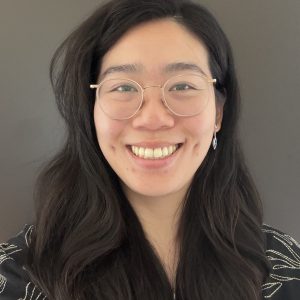
Dr Jennifer Pi, University of New South Wales
Jennifer Pi obtained her PhD in Mathematics at the University of California, Irvine in 2024. She has since been a postdoc at the University of Oxford, and is set to join the University of New South Wales, Sydney later in 2026. Her research lies primarily in model theory for operator algebras, though she also studies free probability. Outside of mathematics, she enjoys cooking, hiking, and horror films.