
Analytic Number Theory
Lecturer
Professor Tim Trudgian, UNSW Canberra
Adj. Assoc. Prof. Adrian Dudek, University of Queensland
Synopsis
Analytic Number Theory is a mesmerising field where tools from analysis are used to study discrete sets, the most central of these being the prime numbers. The course will start with the basics and build towards a proof of the celebrated Prime Number Theorem.
Course Overview
Week 1: Initial prime number estimates, arithmetic functions and Dirichlet convolution.
- We will start by introducing and proving tools such as partial summation that connect analysis with number theory. From there, we immediately consider the prime counting function $\pi(x)$ and prove Chebyshev’s theorems, that is, that there exists constants $A$ and $B$ such that $Ax < \pi(x) < Bx$ for all $x \geq 1$. We then prove asymptotic results for the sum of the reciprocals of the prime numbers as well as Mertens’ three theorems. After establishing these basic results for the prime numbers, we turn to introducing arithmetic functions (the Euler totient function, the divisor functions, the Mobius function and the von Mangoldt function) as well as introducing the notion of Dirichlet convolution along with several key properties.
Week 2: Mobius inversion, formal Dirichlet series, average orders, hyperbola method.
- Here we prove that the set of arithmetic functions forms a ring and we show how (Mobius) inversion works. We then introduce formal Dirichlet series, the simplest such example being the Riemann zeta-function, and show how these resolve into Euler products, particularly in the case of when the underlying arithmetic function is multiplicative, a property we also define and explore. The hyperbola method is then introduced, which allows us to estimate the sum of an arithmetic function that can be expressed as the convolution of two other arithmetic functions whose sums are already well-estimated.
Week 3: Further properties of the Riemann zeta-function.
- We lean light on material this week, allowing for discussions on the previous weeks material to roll over a little bit. The main goal here is to prepare the scene for an analytic proof of the Prime Number Theorem in the final week. As such, we discuss the convergence of the Riemann zeta-function, its analytic continuation and prove the fact that the $\zeta(s)$ has no zeroes of the form $s=1+it$; this is equivalent to the PNT, a connection we will prove in the final week.
Week 4: The zeroes of the zeta-function, the Prime Number Theorem.
- First, we sketch the classic proof of the PNT which involves a contour integration (Perron’s formula). We state the Riemann von Mangoldt explicit formula that shows the connection between the prime numbers and the zeroes of the Riemann zeta-function. We then state and prove some basic ideas and results from Fourier analysis. We then give a rigorous proof of the PNT, but we choose a proof that is Fourier analytic in nature and ultimately prove the more general form of the PNT which is known as the Ikehara-Wiener theorem. This shows more clearly the equivalence between the PNT and the exclusion of zeroes on the 1-line, whereas the classic proofs were not able to demonstrate this. We also note the applicability of the Ikehara-Wiener theorem to other Dirichlet series.
Prerequisites
- Very basic number theory, specifically knowledge of the fundamental theorem of arithmetic and its proof.
- An understanding of complex valued functions and the convergence of complex number sequences. However, an entire course in complex analysis will not be needed, as a contour-integral proof of the PNT will only be sketched. The proof of the PNT we will give will be Fourier analytic, and the minimal amount of theory required here will be provided in Week 4.
Assessment
- 2x Problem sheets – 20% each (40% total)
- Problem sheet 1 – distributed end week 1; due end week 2)
- Problem sheet 2 – distributed end week 2; due end week 3)
- Final Exam (to be invigilated in home city) – 60%
Resources/pre-reading
There is no prescribed pre-reading, though the course will closely follow Tenenbaum’s Introduction to Analytic and Probabilistic Number Theory (2015). Keen students may want to look ahead.
Not sure if you should sign up for this course?
Take this pre-enrolment QUIZ to self evaluate and get a measure of the key foundational knowledge required.

Professor Tim Trudgian, UNSW Canberra
Tim is a Professor at UNSW Canberra. Originally from Brisbane, he obtained a DPhil in mathematics from Oxford and returned to Canberra, after a two-year post-doc in Canada. His research interests lie in analytic number theory such as the Riemann zeta-function, distribution of primes, and primitive roots. He is a part of the Number Theory Group at UNSW Canberra and works closely with colleagues in number theory at UNSW Sydney.
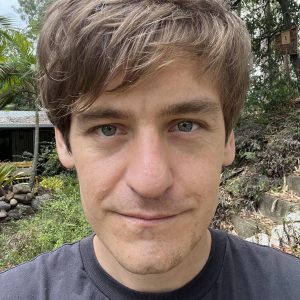
Adjunct Associate Professor Adrian Dudek, The University of Queensland
Adrian grew up in Perth and completed a maths degree at UWA before doing a PhD in number theory at ANU under the supervision of Tim Trudgian. Without first seeking Tim’s approval, Adrian then worked as an options trader at Optiver in Sydney for five years. These days, he still spends most of his time at Optiver, where he mostly heads out to universities to talk about maths in industry. He is also an Adjunct Associate Professor at UQ where he continues his research in number theory whilst supervising honours/PhD students.